The Moving Office: How Elite Executives Turn Every Mile Into a Competitive Advantage

There is a persistent myth in American business culture that the most productive professionals are the ones chained to their desks longest. The corner office, the standing meetings, the back-to-back calendar — these are the familiar symbols of executive output. Yet some of the most consequential decisions in corporate America are not made in conference rooms. They are made in the back of a vehicle, moving quietly through city streets or along an airport expressway, while someone else handles the wheel.
The executives who understand this are not simply enjoying a luxury. They are exploiting a structural advantage that their competitors, still white-knuckling their own steering wheels through rush-hour traffic, have not yet recognized.
Reclaiming Time That Was Never Actually Lost
The average American professional spends more than 200 hours per year commuting. For senior executives in major metropolitan areas — New York, Chicago, Los Angeles, Dallas, Atlanta — that number climbs considerably higher. Most of that time, when spent driving, is functionally lost. The cognitive demands of navigating traffic, monitoring signals, and managing lane changes are modest but continuous, consuming just enough mental bandwidth to prevent genuine strategic thought.
The math is straightforward. An executive logging two hours of daily commute time, five days a week, accumulates roughly 500 hours annually in transit. If even half of that time could be redirected toward productive work, the result is the equivalent of more than three additional work months per year — without adding a single hour to the calendar.
Professional chauffeur services do not simply provide transportation. They restore those hours to full utility.
What Top Performers Actually Do in the Back Seat
The range of high-value activity that takes place inside a professionally chauffeured vehicle might surprise those who have not experienced it firsthand. It is not passive. It is not restful, at least not always. It is, in many cases, the most focused and uninterrupted work an executive will accomplish in a given day.
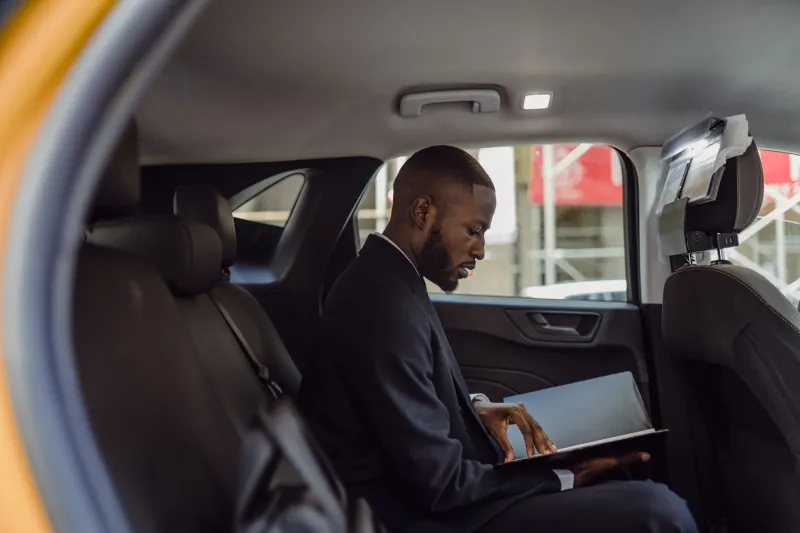
Strategic preparation before high-stakes meetings. The forty-five minutes between a hotel and a client's headquarters is not wasted in a chauffeured vehicle. Executives use it to review briefing documents, rehearse talking points, study competitor intelligence, and mentally rehearse the arc of a negotiation. Arriving to a meeting having just concluded that review is categorically different from arriving frazzled from a parking garage sprint.
Secure conference calls and deal conversations. The interior of a premium chauffeured vehicle offers a degree of acoustic privacy that open-plan offices rarely match. C-suite executives regularly use transit time for sensitive calls — board-level conversations, M&A discussions, legal consultations — that cannot practically happen in shared office environments. With professional drivers trained to maintain confidentiality and minimize distraction, the vehicle becomes a genuinely secure communications environment.
Correspondence and decision queues. The accumulation of unanswered emails, pending approvals, and flagged decisions is a chronic problem for senior leaders. Transit time, with a reliable cellular or Wi-Fi connection and no physical interruptions, is uniquely suited to processing this backlog. Executives who travel with professional chauffeurs routinely arrive at their first appointment having already cleared the morning's decision queue.
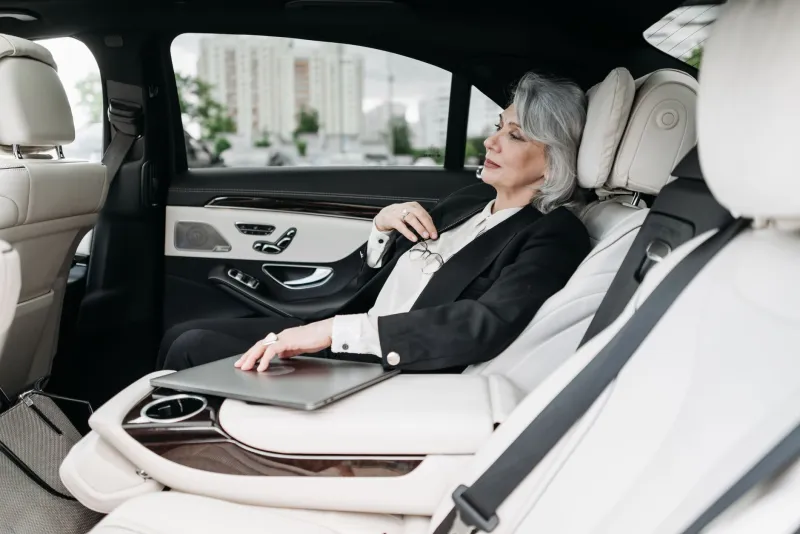
Decompression and cognitive reset. Productivity is not purely about output volume. The transition between high-intensity engagements — moving from a board presentation to a client dinner, for instance — requires a form of mental recalibration that is impossible while driving. A chauffeured ride provides the space to decompress, reorient, and arrive at the next engagement genuinely present rather than still processing the last one.
The Cognitive Cost of Driving That Nobody Talks About
Driving is deceptively taxing. Research in cognitive psychology consistently demonstrates that operating a vehicle, even on familiar routes, consumes meaningful attentional resources. The brain engaged in driving is not simultaneously capable of the deep processing required for complex problem-solving, creative thinking, or nuanced judgment.
For executives whose comparative advantage lies precisely in those higher-order cognitive functions, this is not a trivial trade-off. Every mile driven is a mile during which the brain's most valuable capabilities are unavailable. The executive who drives to a negotiation has spent thirty minutes in a mentally constrained state immediately before needing to perform at their highest level.
The executive who arrives by professional chauffeur has spent those same thirty minutes in exactly the cognitive mode the meeting requires.
The Compounding Effect Over Time
Individual productivity gains compound. An executive who reclaims two productive hours per day, every business day, does not simply gain time — they gain momentum. Decisions get made faster. Preparation is more thorough. Follow-through improves because the administrative backlog never reaches critical mass. The quality of thinking improves because the cognitive load of driving has been permanently removed from the equation.
Over a year, over a career, these gains are not marginal. They are structural. They represent a fundamentally different relationship with time — one in which transit is not subtracted from productive capacity but integrated into it.
This is the logic that has made professional chauffeur services standard practice among executives at the highest levels of American business. It is not indulgence. It is arithmetic.
What the Vehicle Itself Communicates
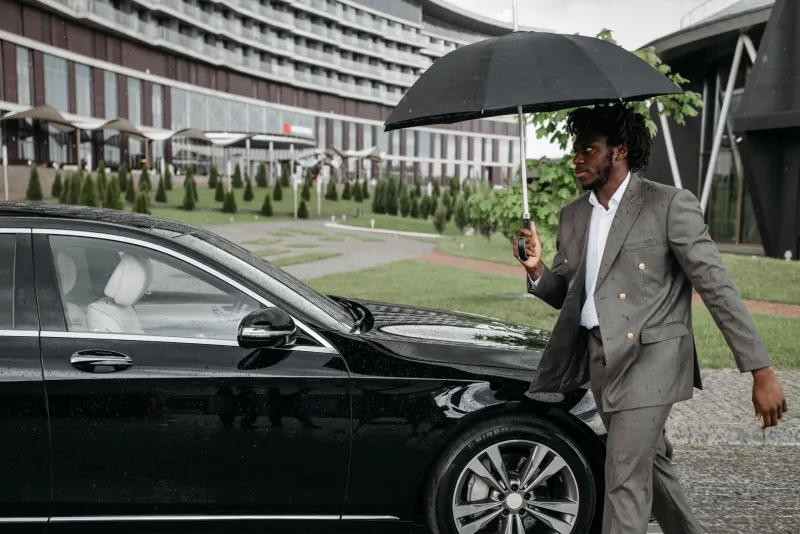
There is a secondary advantage to professional ground transportation that operates alongside the productivity gains, and it is worth acknowledging directly. The vehicle in which an executive arrives communicates something — to clients, to partners, to the professionals waiting in the lobby. A polished, professionally operated luxury vehicle signals organizational competence, attention to detail, and a caliber of operation consistent with the expectations of high-level business relationships.
For executives whose work involves continuous impression management — and at the C-suite level, nearly all work does — this is not a superficial consideration. It is an extension of the same strategic thinking that governs every other element of professional presentation.
Making the Transition
For executives who have not yet structured their ground transportation around a professional chauffeur service, the transition is simpler than it might appear. It begins with identifying the highest-value transit windows in a typical week — airport transfers, cross-town client meetings, early-morning drives to first appointments — and reserving those specifically for chauffeured travel.
The productivity gains tend to be immediately apparent. The cognitive difference between arriving at an important meeting having spent the prior thirty minutes in focused preparation versus focused driving is not subtle. Most executives who make the switch do not revert.
At CapStar Chauffeurs, we have built our service around precisely this understanding. Every vehicle, every route, and every professional driver is selected and trained with a single operating principle in mind: the time our clients spend in transit should be among the most valuable time in their day.
The commute was never wasted time. It was simply time that had not yet been claimed.