Logistics Are Strategy: How Ground Transportation Decisions Shape Deal Outcomes Before Anyone Shakes Hands
There is a persistent myth in American corporate culture that negotiation begins the moment two parties sit across a table from one another. Experienced dealmakers know otherwise. The conditions under which an executive arrives — the quality of preparation achieved in transit, the physical composure maintained through a grueling travel itinerary, the precision of timing that signals both competence and respect — constitute an invisible negotiation that begins hours, sometimes days, before the first handshake.
For executives engaged in multi-city business travel, ground transportation is not a logistical afterthought. It is a strategic variable. And those who treat it as such consistently demonstrate a measurable advantage in the outcomes they achieve.
The Pre-Meeting Window Is Not Dead Time
Consider the typical executive travel sequence for a significant transaction: an early morning flight from New York to Chicago, a connection to Los Angeles, and a high-stakes pitch scheduled for 3:00 p.m. the same afternoon. The natural instinct is to focus preparation energy on the presentation itself — the slides, the financial models, the anticipated objections. What often goes unexamined is how the hours between landing at LAX and entering the conference room will be spent.
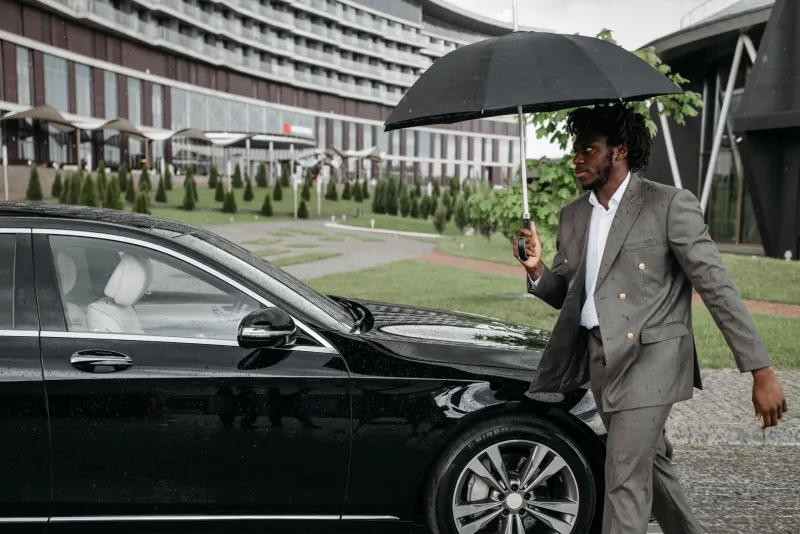
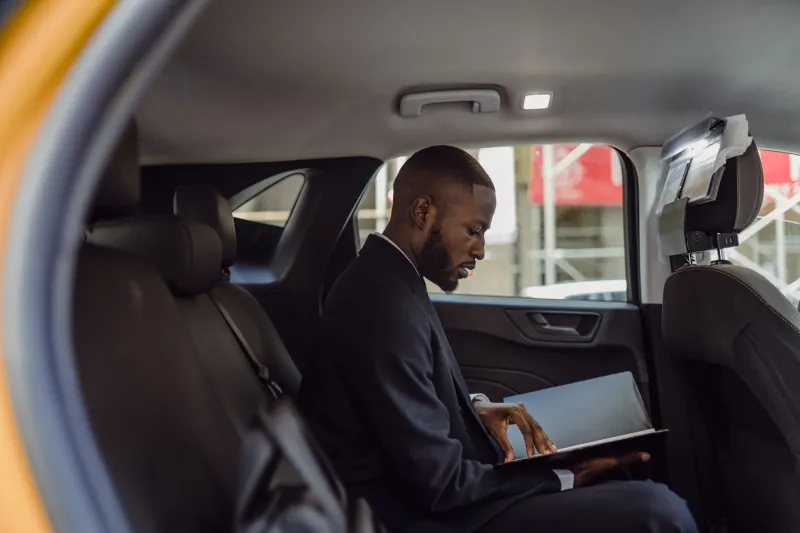
An executive who has arranged private chauffeur service through a professional ground transportation provider arrives at the airport to a waiting vehicle, is greeted by name, and steps into a quiet, climate-controlled environment designed for productivity. The drive from the airport to the meeting location becomes a mobile office. Documents can be reviewed. Final talking points can be rehearsed. A brief call with legal counsel can be completed without the ambient chaos of a rideshare or the cognitive distraction of navigating an unfamiliar city.
The executive who did not make that arrangement is doing something else entirely: standing at a rideshare pickup zone, refreshing an app, managing surge pricing anxiety, and hoping the driver knows an alternate route around the 405. The content of the pitch may be identical. The state of mind upon delivery is not.
Multi-City Itineraries and the Compounding Cost of Friction
Single-city business trips present limited logistical complexity. It is the multi-city, multi-meeting itinerary — the kind that defines major transactions, coast-to-coast merger discussions, and extended client acquisition campaigns — where transportation coordination becomes genuinely consequential.
Imagine a managing director conducting due diligence meetings across four cities in five days: Boston, Atlanta, Dallas, and San Francisco. Each leg of the trip introduces new variables: different airports, unfamiliar traffic patterns, varying distances between accommodations and meeting venues. Without a coordinated ground transportation strategy, each city becomes its own logistical puzzle to solve in real time, consuming exactly the cognitive bandwidth that should be reserved for the substance of the negotiations themselves.
Professional chauffeur services with national coordination capabilities eliminate that friction entirely. A single point of contact manages the ground transportation across every city on the itinerary. Vehicles are confirmed, routes are pre-planned, and schedule adjustments — the delayed flight, the meeting that runs long — are absorbed by the transportation provider rather than by the executive. The result is a trip in which mental energy is conserved and redirected toward what actually matters: the deals.
Punctuality as a Power Signal
In high-stakes negotiations, timing is not merely a courtesy. It is a communication. Arriving precisely on time — not breathlessly close, not conspicuously early — signals control. It signals that the executive commands their schedule rather than being commanded by it. It signals, implicitly, that the same discipline applied to timekeeping will be applied to deliverables, commitments, and the management of the transaction itself.
Conversely, arriving late — regardless of the cause — shifts the psychological dynamic in ways that are difficult to recover from. The other party has had time to wait, to wonder, and to form impressions. The executive who arrives flustered, apologetic, or visibly rushed has already ceded ground that the meeting itself may not reclaim.
Professional chauffeur services are built around the operational imperative of punctuality. Flight tracking, real-time traffic monitoring, and pre-planned contingency routes are standard features of a quality provider. These are not amenities. They are risk mitigation tools that protect one of the executive's most valuable negotiating assets: the authority that comes from arriving exactly when you said you would.
The Refreshed Executive Versus the Depleted One
Physical and cognitive fatigue are negotiating liabilities. Research consistently demonstrates that decision-making quality, emotional regulation, and persuasive capacity all degrade under conditions of sustained stress and exhaustion. Multi-city business travel is, by its nature, physiologically demanding. The question is not whether fatigue will be a factor but how aggressively it will be managed.
The executive who spends transit time in a professionally appointed vehicle — seated comfortably, insulated from noise and distraction, able to rest or prepare as the moment requires — arrives at each meeting in materially better condition than one who has spent that time navigating transportation logistics. Over the course of a five-day, multi-city trip, that differential compounds. By the final meeting — often the most critical one, where terms are agreed and commitments are made — the executive who managed their energy deliberately has a meaningful advantage over one who did not.
When the Other Side Is Watching
It would be naive to suggest that counterparties in significant transactions are indifferent to how the other side arrives. In certain industries — private equity, real estate investment, financial services, entertainment — the quality of presentation extends to every observable detail. A car service that reflects professionalism and organizational competence reinforces the narrative that the executive and their firm bring to the table. It is a subtle signal, but subtle signals accumulate.
This is not an argument for performative excess. It is an argument for coherence. An executive representing a firm that manages hundreds of millions in assets, arriving in a vehicle that contradicts that positioning, introduces a dissonance that sophisticated counterparties register even if they do not articulate it.
Outsourcing the Logistics to Own the Outcome
The executives who close the most consequential deals share a common discipline: they are ruthlessly protective of their attention. They identify which decisions and tasks require their personal engagement and which can be delegated to capable professionals. Ground transportation logistics fall unambiguously into the second category.
A professional chauffeur service does not merely move an executive from one location to another. It absorbs the logistical complexity of travel, preserves cognitive resources for higher-order priorities, and ensures that the executive arrives at every meeting in the optimal condition to perform. In that sense, it is not a travel expense. It is an investment in deal quality.
The invisible negotiation is always underway. The executives who recognize it — and who plan accordingly — arrive not merely on time, but ahead.