The Hidden Hours: How Professional Chauffeur Services Unlock an Executive's Most Valuable Resource

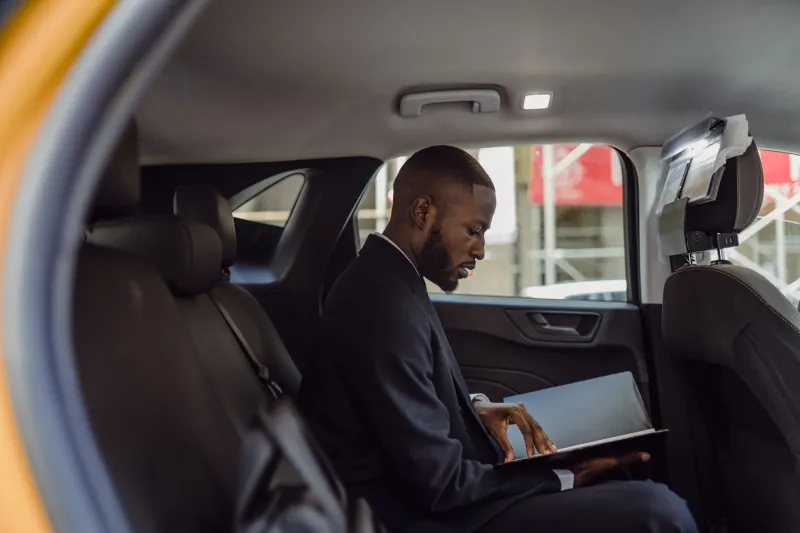
Photo: executive working on laptop in luxury car backseat professional chauffeur, via www.moskyt.net
For senior executives, time is not merely money — it is leverage, influence, and competitive advantage compressed into finite daily increments. Professional chauffeur services are quietly transforming how America's most productive leaders reclaim hundreds of hours each year. This is not a conversation about comfort; it is a conversation about output.
The Productivity Paradox Hidden in Plain Sight
America's C-suite faces a paradox that rarely appears on any strategic roadmap: the people most responsible for high-stakes decisions are routinely asked to surrender their cognitive capacity to traffic signals, parking garages, and highway merges. A senior executive spending ninety minutes behind the wheel each day — a figure conservative by standards in cities such as Los Angeles, Chicago, or Atlanta — surrenders approximately 390 hours annually to a task that generates no organizational value whatsoever.
That figure is not incidental. It represents nearly ten standard work weeks. In those hours, a leader might have reviewed quarterly projections, prepared for board presentations, cultivated key client relationships, or simply thought clearly about the decisions that define their tenure. Instead, those hours vanish into the commute.
The meeting overload crisis that plagues modern executive life is well-documented. Senior leaders report spending upward of 23 hours per week in meetings — a number that has more than doubled since the 1960s, according to research from Harvard Business School. What receives far less attention is the compounding effect of transit time on that burden. When an executive drives themselves between engagements, they arrive at each meeting having already depleted a portion of their mental reserves. The cognitive cost of navigating traffic is real, measurable, and cumulative.
Converting Dead Miles Into Decisive Moments
Professional chauffeur services do not simply move executives from one location to another. They transform transit into a functional extension of the workday. The mathematics are straightforward: thirty minutes in the rear of a professionally managed vehicle, with reliable connectivity, privacy, and comfort, is thirty minutes that can be applied to email triage, call preparation, or document review. Multiply that across a full schedule and the reclamation becomes substantial.
Consider the executive preparing for a high-stakes negotiation. The traditional model requires that individual to park, walk, compose themselves in a lobby, and arrive having spent the preceding forty-five minutes managing lane changes. The professional ground transportation model allows that same executive to spend those forty-five minutes reviewing term sheets, rehearsing key talking points, or concluding a preparatory call — and to step out of the vehicle composed, focused, and mentally present.
This is the workforce multiplier argument that finance teams and chief of staff officers are beginning to quantify. When an executive's fully loaded compensation is calculated against recoverable hours, the return on investment for professional transportation services becomes difficult to dismiss. An executive earning $500,000 annually works at an effective hourly rate exceeding $240. Recovering 250 hours through professional ground transportation represents a theoretical productivity value of more than $60,000 — against a service cost that represents a fraction of that figure.
The Meeting Schedule Reimagined
Beyond raw hour recovery, professional chauffeur services alter the structure of the executive workday in ways that compound over time. When transit is reliable, punctual, and private, executives can schedule with greater precision. The buffer time that typically exists between engagements — time inserted to account for parking, navigation uncertainty, and the psychological recovery from driving in dense urban traffic — can be reduced or repurposed.
In cities such as New York, Boston, and San Francisco, where traffic unpredictability is a genuine operational variable, professional chauffeur services provide a layer of schedule insulation that self-driving cannot. Experienced chauffeurs understand routing, monitor real-time conditions, and adjust proactively. The executive in the rear seat does not carry that cognitive burden. Their attention remains on the agenda ahead, not the congestion behind.
Email management, often cited as one of the most time-consuming and disruptive elements of executive life, becomes substantially more manageable when transit time is reclaimed. A study by McKinsey Global Institute found that executives spend an average of 28 percent of their workday reading and responding to email. The ability to address that workload during transit — rather than allowing it to accumulate until late evening — reduces the spillover that erodes both personal time and decision-making quality.
Strategic Thinking Requires Uninterrupted Space
There is a dimension of executive productivity that resists easy quantification but deserves direct acknowledgment: the quality of thought that emerges from uninterrupted, low-stimulus environments. Many of the most consequential decisions in business history were not made in boardrooms. They were made in the quiet intervals between formal engagements — in the moments when a leader's mind was free to process, connect, and synthesize.
Driving eliminates those intervals. The cognitive demands of operating a vehicle — even on familiar routes — occupy precisely the neural bandwidth required for reflective thinking. Professional chauffeur services restore those intervals. The executive seated in a well-appointed vehicle, moving through a city without responsibility for navigation, has access to a form of productive solitude that is increasingly rare and correspondingly valuable.
At CapStar Chauffeurs, this philosophy shapes every engagement. Our professional chauffeurs are trained not merely to transport clients efficiently, but to create the conditions under which serious work and serious thinking become possible. The vehicle is not incidental to the executive's day. In the right hands, it is an extension of their office — quiet, reliable, and entirely oriented toward their priorities.
Reframing the Expense
Organizations that categorize professional ground transportation exclusively as a hospitality or entertainment expense are, in a meaningful sense, misreading their own balance sheets. When viewed through the lens of executive capacity, talent retention, and time-to-decision efficiency, professional chauffeur services belong in a different category entirely: operational infrastructure.
The most competitive organizations in the United States have already arrived at this conclusion. Professional ground transportation for senior leadership is not a concession to preference. It is a deliberate investment in the conditions under which their most valuable people perform at the highest level.
The hours are there. The question is whether your organization is structured to claim them.