Before You Speak, You've Already Been Judged: The Strategic Power of How You Arrive
Before You Speak, You've Already Been Judged: The Strategic Power of How You Arrive
There is a moment — brief, almost imperceptible — that occurs just before every consequential meeting. It happens at the curb, in the lobby, or beneath the portico of a hotel. Someone glances up, registers what they see, and forms a judgment that will quietly color every exchange that follows. You may never know it happened. But it did.
In the lexicon of behavioral psychology, this phenomenon is called thin-slicing: the mind's remarkable ability to extract accurate, lasting impressions from the thinnest slice of observed behavior. Princeton researchers Janine Willis and Alexander Todorov demonstrated that people form confident assessments of trustworthiness, competence, and status within a fraction of a second of seeing someone. What their studies did not fully account for was the prologue — the context that frames the person before they even appear.
Your arrival is that prologue.
The Unspoken Grammar of Luxury
Every culture develops a set of visual shorthand — symbols that communicate meaning without requiring explanation. In American corporate life, few symbols carry more concentrated meaning than the vehicle that deposits you at the door of a negotiation or a high-profile event.
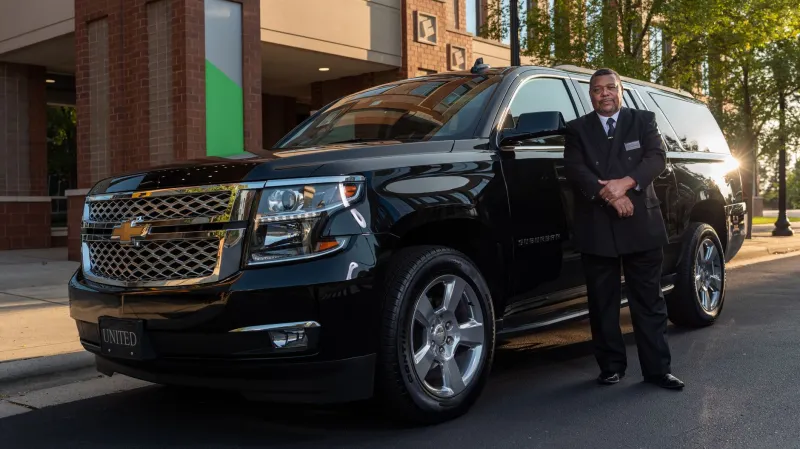
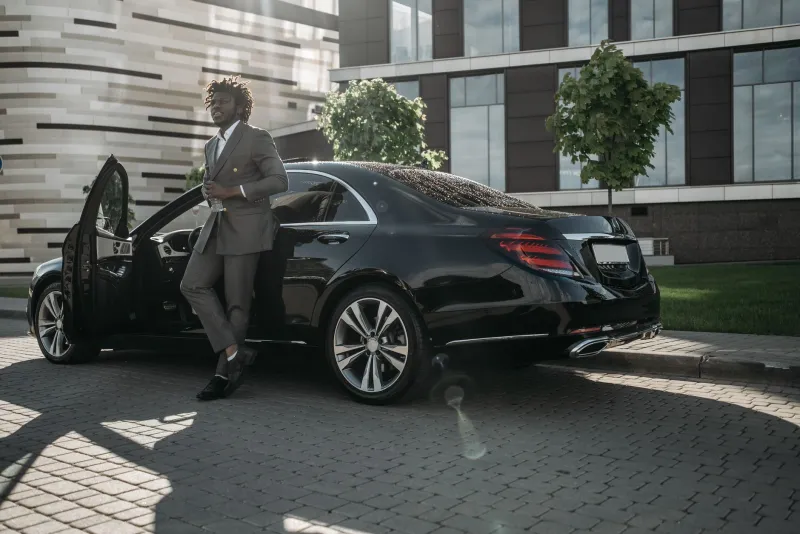
This is not about ostentation for its own sake. The distinction between arriving in a polished, late-model luxury sedan with a uniformed, professional chauffeur versus stepping out of a rideshare — wrestling with a door handle, squinting at your phone — is not merely aesthetic. It is informational. It tells the people watching something about how you organize your life, how you value your time, and whether the details matter to you.
In deal-making environments, details matter enormously. A senior partner at a Chicago-based private equity firm once described his firm's unwritten policy this way: "We watch how people arrive for the first meeting. Not because we're snobs — because attention to the small things predicts attention to the large things." He was not alone in that instinct. Across industries, from entertainment to finance to law, the people who close the largest deals tend to share a particular characteristic: they treat every touchpoint as a deliberate communication.
Your ground transportation is a touchpoint.
Status, Intentionality, and the Psychology of Preparation
Behavioral economists have long studied what they call signaling — the way individuals and institutions communicate credibility and capability through observable choices. In competitive markets where information is asymmetric, signals serve as proxies for qualities that cannot be directly verified. A law firm's address signals its standing. A watch signals its wearer's relationship with quality. An arrival in a sleek, impeccably maintained black car signals something too: that this person planned, that they prepared, and that they do not leave important moments to chance.
This matters most precisely when the stakes are highest. Consider the dynamic before a major client pitch. Both parties arrive with uncertainty — the client uncertain about the firm, the firm uncertain about the client's seriousness. Signals reduce that uncertainty. When one party arrives composed, unhurried, and visibly organized — having been delivered to the door rather than having navigated traffic, parking garages, and rideshare logistics — they enter the room with a measurable psychological advantage. They have already communicated competence without opening their mouth.
The reverse is equally true, and perhaps more powerful. Arriving flustered, late, or visibly stressed because of a transportation failure does not merely inconvenience you. It erodes the very authority you need to project. In the theater of high-stakes business, the audience begins reading the performance before the curtain rises.
The Cultural Weight of the Black Car
America has its own particular relationship with the luxury sedan and the professional chauffeur. Unlike some European traditions where the chauffeured car is simply an aristocratic inheritance, the American version carries a different resonance — one tied to earned achievement, to the idea that success has a texture and a discipline to it. The black car is not a birthright here. It is a choice, and choices reveal character.
In cities like New York, Los Angeles, Chicago, and Houston — where the density of high-stakes encounters is greatest — this cultural literacy is especially acute. The people who populate boardrooms, greenrooms, and private dining rooms in these cities are practiced readers of context. They notice. A chauffeured arrival, executed with quiet precision, communicates that you understand the register you are operating in and that you have chosen to honor it.
There is also an element of respect embedded in the choice. Arriving via professional ground transportation signals to your host or counterpart that you valued the occasion enough to prepare for it fully — that you did not simply improvise your way to their door. In a culture that often conflates busyness with importance, the deliberate calm of a well-orchestrated arrival is its own form of authority.
Distinction Begins at the Curb
At CapStar Chauffeurs, we have always understood that our role is not merely logistical. Every client we serve is, in some sense, making a statement — about their standards, their priorities, and the seriousness with which they approach the moments that matter. Our fleet, our chauffeurs, and our commitment to flawless execution are designed with that understanding at the center.
The executives, entertainers, legal professionals, and discerning travelers who choose CapStar are not paying for a ride. They are investing in the right opening line — the one that is delivered before they ever say a word.
Because the most powerful communication is often the kind that happens in silence: in the gleam of a well-maintained vehicle, in the unhurried confidence of a professional who opens the door and steps aside, in the composed, prepared presence of someone who arrived exactly as they intended to.
In competitive environments, that composure is not incidental. It is the foundation upon which everything that follows is built.
The question is not whether your arrival communicates something. It always does. The question is whether you are the one deciding what it says.