Tarmac to Table: The Executive Traveler's Definitive Guide to Ground Transportation in America's Busiest Business Cities
Tarmac to Table: The Executive Traveler's Definitive Guide to Ground Transportation in America's Busiest Business Cities
A business trip does not begin when you walk through the conference room door. It begins the moment your flight lands — and in many cases, the quality of what happens between the tarmac and the table determines the tone of everything that follows. For high-end business travelers operating in and out of America's most demanding airport hubs, ground transportation is not a logistical footnote. It is a strategic variable.
This guide is designed for the professional who understands that distinction. Whether you are landing at JFK ahead of a Wall Street presentation, deplaning at O'Hare before a manufacturing summit in the Loop, navigating LAX en route to a Century City negotiation, or touching down at Dallas/Fort Worth before a corporate dinner in Uptown, the principles below will help you travel with the precision your schedule demands.
Know Your Airport Before You Book Your Car
Every major American airport has its own geography, its own traffic patterns, and its own unwritten rules. Understanding these nuances is the first step toward designing a ground transportation experience that works rather than one that merely functions.
John F. Kennedy International (JFK), New York: JFK is a sprawling, multi-terminal complex where the distance between arrival and departure can rival the flight itself. Traffic on the Van Wyck Expressway and the Belt Parkway is notoriously unpredictable, with peak congestion typically occurring between 7:00–9:30 a.m. and 4:30–7:00 p.m. on weekdays. For meetings in Midtown Manhattan, budget no fewer than 60 to 90 minutes under normal conditions — and more during inclement weather or major events. A pre-arranged chauffeur who monitors your flight in real time and adjusts pickup timing accordingly is not a convenience here. It is a necessity.
O'Hare International Airport (ORD), Chicago: O'Hare is one of the busiest airports in the world, and its ground transportation infrastructure reflects that complexity. The I-90/94 corridor connecting O'Hare to downtown Chicago's Loop is subject to severe congestion during morning and evening rush hours. The journey that takes 25 minutes at 10:00 a.m. on a Sunday can stretch to 75 minutes or more on a Friday afternoon. Experienced chauffeurs serving O'Hare often utilize alternative routing — including I-190 and surface streets through River North — to manage timing more reliably than any navigation app.
Los Angeles International (LAX), Los Angeles: LAX presents a unique set of challenges driven not only by traffic volume but by the sprawling geography of Los Angeles itself. Century City, Beverly Hills, downtown, and Santa Monica all require different routing strategies and time buffers. The I-405 is among the most congested freeways in the country; during peak hours, a skilled chauffeur may route via La Cienega Boulevard, Lincoln Boulevard, or other surface alternatives to maintain schedule integrity. For early-morning or late-evening arrivals, the LAX Automated People Mover connecting to the new consolidated rental car facility has altered pickup logistics — another reason a professional service that stays current with airport infrastructure changes is invaluable.
Dallas/Fort Worth International (DFW), Texas: DFW is the fourth-busiest airport in the United States and serves as a major hub for corporate travel across the South and Midwest. Its distance from both downtown Dallas and downtown Fort Worth — approximately 17 and 14 miles respectively — means that timing and route selection are critical. The morning rush on I-635 and SH 114 can be severe, while midday travel windows are often surprisingly efficient. For executives with afternoon meetings in the Uptown or Arts District corridors, a 90-minute pre-arrival buffer is a reasonable professional standard.
Matching the Vehicle to the Occasion
Not all professional engagements call for the same vehicle, and selecting the right one is a mark of sophisticated travel planning.
The Executive Sedan — typically a Lincoln Continental, Mercedes-Benz E-Class, or equivalent — is the standard bearer for individual business travel. Quiet, refined, and efficient, it communicates professionalism without ostentation. Ideal for solo airport transfers, one-on-one client pickups, and any engagement where discretion is paramount.
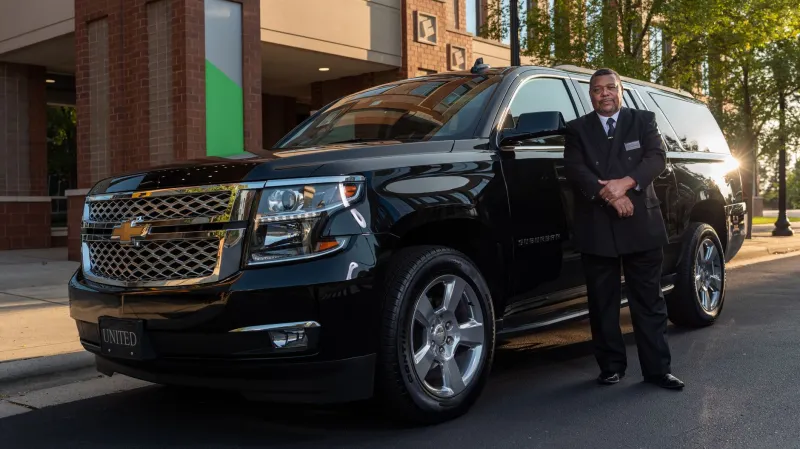
The Luxury SUV — a Cadillac Escalade, Chevrolet Suburban, or Mercedes-Benz GLS — accommodates small delegations traveling together, provides additional luggage capacity, and offers a commanding presence appropriate for group client entertainment or multi-executive transfers. In cities like Dallas and Los Angeles, where SUVs are culturally normative at the executive level, this vehicle class requires no explanation.
The Executive Van or Sprinter — best suited for larger corporate groups, board delegations, or conference transport. When a team of six to twelve professionals needs to arrive at the same venue simultaneously, a premium Sprinter configured with business seating ensures that the journey itself becomes an extension of the pre-meeting briefing.
Timing Is the Most Underrated Element of Business Travel
Among experienced corporate travelers, there is a widely shared but rarely articulated rule: never leave your arrival logistics to the last minute, and never assume that a shorter distance means a shorter journey.
The most effective approach is to build your ground transportation schedule backward from your first commitment. Determine when you need to be seated, composed, and ready — not walking through the door, but settled. Then calculate the realistic transit time based on time of day, day of week, and local event calendars. Add a buffer of no fewer than 15 to 20 minutes. Then book your chauffeur service accordingly.
Pre-arranged professional services offer flight tracking as a standard feature, meaning that if your arrival is delayed, your driver is already aware and has adjusted. This eliminates the frantic scramble of rebooking a rideshare after an unexpected gate change — a scenario that has derailed more than a few important meetings.
The Friction That Rideshare Cannot Eliminate
App-based rideshare platforms are engineered for the average traveler. They are not designed for the professional whose calendar does not accommodate error. The wait time variability, the inconsistent vehicle standards, the absence of a direct line to a human being when something changes — these are not design flaws. They are design trade-offs that the average user accepts. The executive traveler, however, is not the average user.
A dedicated chauffeur service removes that friction entirely. There is a named driver. There is a confirmed vehicle. There is a dispatch team reachable by phone. There is accountability at every point in the journey. When the stakes of a business engagement are high — and for the professionals this guide is written for, they almost always are — that accountability is the difference between a travel experience that supports your objectives and one that undermines them.
Meticulous Planning as a Professional Standard
The executives who arrive most consistently prepared are not those with the best luck. They are those who have decided, deliberately, that every controllable variable in their professional life will be controlled. Ground transportation is one of those variables.
At CapStar Chauffeurs, we design every engagement around that standard. From real-time flight monitoring and meet-and-greet service at the arrivals hall to door-to-door coordination in New York, Chicago, Los Angeles, Dallas, and beyond, our commitment is to ensure that the distance between your tarmac and your table is the least complicated part of your day.
Because when you travel without compromise, you arrive ready to lead.