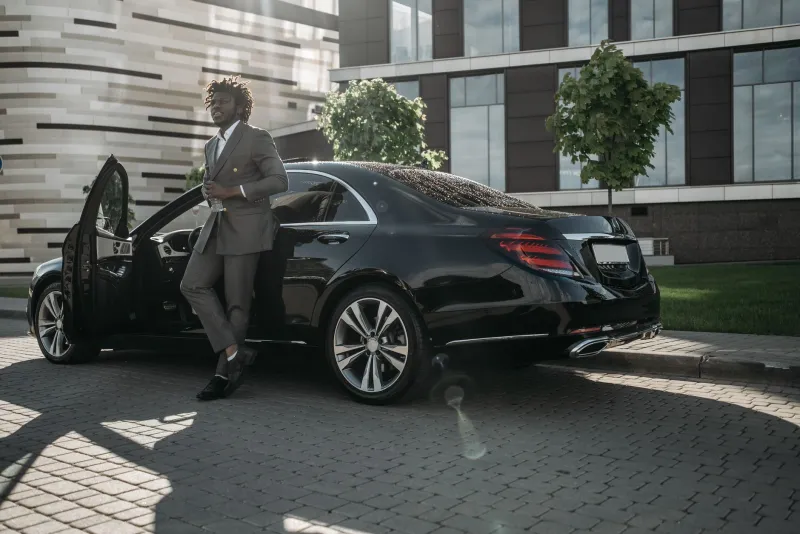
What Arrives Before You Do: The Negotiation Edge That Begins With Your Chauffeur

In high-stakes deal-making, the margin between a signed agreement and a collapsed opportunity can be measured in minutes. Seasoned executives understand that every variable within their control must be managed with precision — and how they arrive at the table is among the most consequential of those variables. Professional chauffeur service is not an indulgence; it is a strategic instrument of negotiation readiness.
The Psychology of Punctuality in a Boardroom Context
Behavioral economists and negotiation scholars have long documented the outsized influence of first impressions on the trajectory of complex deals. What is discussed less frequently — but no less important — is the impression formed in the minutes before a meeting formally begins.
When a senior executive arrives late to a negotiation, even by a modest margin, the psychological damage is rarely proportional to the delay itself. The opposing party has had time to recalibrate their expectations, harden their positions, or — worse — begin to question whether this partnership reflects the level of seriousness they require. Lateness signals disorder. It implies that the late party's time management, and by extension their organizational discipline, may be unreliable.
Conversely, arriving with composed confidence — unhurried, well-rested, mentally prepared — communicates authority before a single word is exchanged. The executive who steps into a room having been chauffeured in a quiet, climate-controlled environment, without navigating traffic, hunting for parking, or managing rideshare logistics, carries a measurable psychological advantage.
The Variables You Cannot Afford to Leave to Chance
Consider the standard alternatives to professional chauffeur service available to a busy executive in any major American city. Driving personally introduces variables including traffic unpredictability, parking availability, and the cognitive load of navigation — none of which are trivial when the destination is a negotiation that could define the next several years of a company's trajectory.
Rideshare platforms, while convenient for casual travel, introduce an entirely different category of risk. Driver cancellations, inaccurate ETAs, vehicles that do not meet professional standards, and the absence of any accountability mechanism are well-documented realities for frequent users. For a managing director preparing mentally to present a complex acquisition structure, the last experience before entering that room should not be disputing a surge charge or locating a driver who has parked three blocks away.
A dedicated professional chauffeur eliminates these variables entirely. The vehicle is confirmed. The route is monitored in real time. The driver is vetted, trained, and aligned with the client's schedule — not with an algorithm's optimization of driver efficiency.
When Composure Is the Competitive Advantage
One chief operating officer at a mid-sized private equity firm based in Chicago described a turning point in her firm's travel policy following a near-miss at a critical closing meeting in New York. Her car service — a national rideshare account her firm had been using to control costs — resulted in a forty-minute delay due to a driver who accepted the booking and then cancelled upon learning the destination required toll road navigation. She arrived twelve minutes late to a meeting with a counterparty who had flown in from London.
"It wasn't just the twelve minutes," she reflected. "It was walking in flustered, still on the phone with my assistant trying to send an apology, while the other side had been sitting there composing themselves for nearly an hour. I had ceded the psychological high ground before I opened my briefcase."
Her firm subsequently transitioned to a structured chauffeur service arrangement for all senior-level travel. The operational cost increase was, in her assessment, negligible against the value of arriving prepared.
A similar account comes from a general counsel at a healthcare technology company headquartered in Dallas, who credits professional ground transportation with preserving a partnership negotiation that might otherwise have fractured. Delayed by an unexpected flight diversion into a secondary airport, he relied on a chauffeur service that monitored his updated arrival gate and repositioned accordingly — allowing him to reach the meeting location with sufficient time to review documents and gather his thoughts. "The deal closed," he noted simply. "I don't know that it would have if I'd been scrambling for a cab from an unfamiliar terminal."
Reputation Is Built in Aggregate
It is tempting to evaluate any single instance of tardiness as an isolated event — a forgivable anomaly in an otherwise impeccable professional record. Experienced executives, however, understand that reputation is not built in singular moments but in the accumulated weight of many interactions over time.
Counterparties, investors, and board members observe patterns. A professional who consistently arrives prepared, on time, and composed builds a reputation for reliability that extends well beyond any individual meeting. That reputation, once established, carries its own negotiating currency. It signals that commitments made in the boardroom will be honored with the same discipline demonstrated at the door.
Professional chauffeur service is one of the most efficient mechanisms available for protecting that reputation systematically. It removes a category of risk — transportation failure — from the equation entirely, allowing the executive to focus on what genuinely demands their attention.
Selecting a Service That Meets the Standard
Not all chauffeur services are equivalent, and the distinction matters considerably for high-stakes travel. Executives evaluating ground transportation providers should consider several key criteria: real-time flight and schedule monitoring, a vetted and professionally trained driver pool, late-model premium vehicles maintained to exacting standards, and a demonstrated record of reliability in the markets where they travel most frequently.
For executives based in or traveling through major American business corridors — New York, Chicago, Los Angeles, Houston, Atlanta, and beyond — the infrastructure of a professional chauffeur service should be evaluated as carefully as any other operational vendor. The question is not whether the service can get you there, but whether it can get you there in the condition required to perform.
Arriving Ready Is a Choice
The most capable negotiators in any industry share a common understanding: preparation does not end when the briefing documents are reviewed. It extends to every element of the hours preceding a critical engagement — including, and perhaps especially, how one travels to the table.
The executive who arrives via professional chauffeur service arrives having protected their time, their composure, and their focus. They arrive, in the fullest sense, ready. In a context where every advantage compounds, that readiness is not a minor convenience.
It is a competitive edge that begins long before the first handshake.